Small BusinessInvoicingCash Flow
|June 22, 2026
|9 min read
Get Paid Faster: How AI Chases Your Unpaid Invoices So You Don't Have To
You finished the job and sent the invoice, then nothing happened. Slow payment is rarely the customer's fault. It is that following up is nobody's job. Automation fixes that and gets you paid faster, without you nagging anyone.
The Money You Already Earned Is Sitting in Someone Else's Inbox
You finished the job. The customer was happy. You sent the invoice. And then nothing happened.
A week goes by. Then two. You meant to follow up, but you were on another job, or it was late, or you just felt weird about nagging a good customer over money they clearly owe you. So the invoice sits there, and your cash sits in their account instead of yours.
If that sounds familiar, you are not behind on your business. You are normal. Most small companies lose real money this way, not because customers refuse to pay, but because nobody on your side has the time to chase every open invoice the moment it is late. The work of remembering who owes what, and sending a polite reminder at the right moment, almost always falls off the to-do list. There is always something more urgent than money you have not collected yet.
This is one of the cleanest wins automation can give a small business, and it does not require you to change how you run anything. You keep sending invoices the way you already do. You just stop being the person who has to remember to follow up.
Why slow payment quietly drains a small business
Let's put numbers on it, because the numbers are bigger than most owners think.
The gap between sending an invoice and getting paid has a name in the finance world: days to get paid, or how long your money stays parked somewhere else. For a lot of small businesses that number sits around 30 to 35 days, and a chunk of invoices stretch well past that. Industry data from 2026 shows that businesses using automated, multi-touch reminders cut their average collection time from about 34 days down to under 20. That is two extra weeks of your own money back in your account, on every invoice, every month.
Think about what two weeks of cash means when you are the one covering payroll, materials, fuel, and rent. The job is done and paid for on paper, but you are still floating the cost until the check clears. Slow payment is the reason a profitable business can still feel broke on the 15th.
Now add the hours. Chasing invoices is not hard work, but it is fiddly, repetitive, and easy to put off. You have to pull up who owes you, figure out how late each one is, write a message that is firm but friendly, send it, and then remember to do it again if they go quiet. A 2026 survey of small business owners found that admin tasks like this eat hours every week that could go to actual jobs or actual customers. Multiply that across a year and you are looking at weeks of your time spent on something a system could handle without a single reminder from you.
What automated invoice follow-up actually does
Here is the plain version. Automated follow-up watches your unpaid invoices and sends the right message at the right time, on its own, so you never have to think about it.
When you send an invoice, the system starts a quiet clock. If the invoice gets paid, the clock stops and nothing happens. If it does not get paid by the due date, the system sends a friendly reminder. A few days later, if there is still no payment, it sends another, a little firmer. It can include a link so the customer pays right there from their phone in about ten seconds. You set the schedule once, and from then on it just runs.
The newer piece, the part that has gotten genuinely good in the last year, is that the messages do not have to sound like a robot. AI can write a reminder that matches your voice, references the actual job, and stays warm instead of threatening. To a customer it reads like you took a minute to send a personal note. In reality you did nothing. The system wrote it and sent it based on the rules you gave it.
A few things a good setup handles for you:
It knows who is late and who is not, so paid customers never get a nagging message by mistake. That mistake, emailing a reminder to someone who already paid, is the one that actually annoys people, and a system tracks it perfectly.
It sends through the channel that gets read. An email reminder is fine, but a text message gets opened within minutes. For a lot of trades and service businesses, a short, polite text is what finally gets the invoice paid.
It stops the moment money comes in. The customer pays, the follow-up sequence ends automatically, and nobody gets an awkward "you still owe us" note an hour after they settled up.
What this looks like for real businesses
Picture a small remodeling crew. They finish a kitchen, send a $9,000 invoice, and the homeowner means to pay but gets busy. With no follow-up, that invoice might sit for six weeks while the owner feels too polite to push. With automated follow-up, a friendly reminder goes out the day after it is due, a payment link goes with it, and the homeowner pays from the couch that evening. Same customer, same goodwill, two fewer weeks of waiting on nine grand.
Picture an HVAC company running 80 jobs a month. Even if just a quarter of those invoices normally drift past 30 days, that is 20 invoices a month tying up cash. Tighten that up with automatic reminders and you free up thousands of dollars that used to be stuck in limbo, plus you stop spending Friday afternoons going through the books to figure out who to call.
Picture a distributor or wholesaler sending dozens of invoices a week to business customers. Those buyers are not dodging payment, they just have their own piles of paperwork. A steady, automatic reminder lands at the right time and moves your invoice to the top of their stack. The reminder that gets sent beats the reminder you meant to send every time.
The pattern is the same across every one of these. The customers were going to pay. The breakdown was never the customer. It was that following up depended on a busy human remembering to do it.
How to set this up without overhauling your business
You do not need new software for your whole operation. You need three pieces working together, and you probably already have two of them.
Start with where your invoices live. Most small businesses already use something like QuickBooks, a field service app like Jobber or Housecall Pro, or even a simple invoicing tool. Many of these already have reminder settings buried in the menus that you have never turned on. That is step one, and sometimes it is the whole solution: switch on the built-in reminders and pick a schedule.
If your tools do not talk to each other, a connector can bridge them so that sending an invoice automatically kicks off the follow-up sequence, and a payment automatically shuts it off. This is the part that makes it feel effortless instead of like one more app to check.
Then decide your follow-up rhythm. A simple, polite schedule works well for most owners: a friendly nudge the day after the due date, a second one about a week later, and a short personal note if it goes past two weeks. Keep the tone warm. You are reminding a good customer, not collecting a debt. The whole point is that you can be consistent without being the bad guy, because the system sends it, not you.
A few ground rules keep this from backfiring. Always include a way to pay right in the message, because a reminder with no easy payment option just creates more back-and-forth. Make sure paid invoices drop out of the sequence instantly. And read your own reminder messages out loud once before you turn them on, so they sound like you and not like a collections agency.
If you want to take it further, the same approach that gets you paid faster pairs naturally with getting the invoice out faster in the first place. The quicker a customer gets the bill, the quicker the clock starts, which is why a lot of owners tackle this alongside quoting and invoicing faster with AI. And if missed communication is a bigger problem for you than slow payment, the same kind of automatic, instant response works wonders for recovering jobs from missed calls.
The real reason this is worth doing
Most owners think of unpaid invoices as a customer problem. It almost never is. Your customers are not the holdup. The holdup is that chasing money is nobody's actual job, so it happens late, unevenly, or not at all.
Automating the follow-up takes that off your plate completely. You get paid faster, you stop floating other people's bills, and you never again have to decide whether it is too pushy to ask for money you already earned. The system asks, politely and on time, every single time.
It is a small change with an outsized payoff, and it is usually the first thing I help a business turn on, because the money is already yours. It is just sitting in someone else's inbox waiting for a reminder. If you want a hand setting it up around the tools you already use, that is exactly the kind of thing I help small businesses get running.
See it
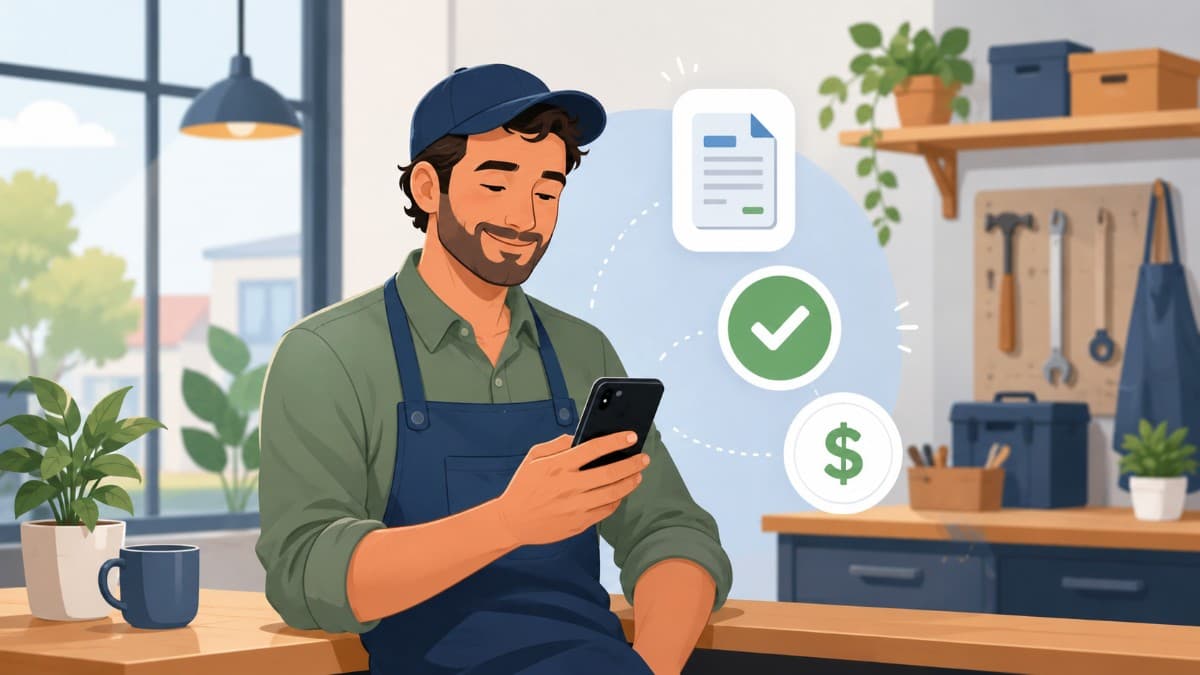
Want the whole thing on one page? Here is the invoice follow-up flow, from finished job to cash in your account two weeks sooner.

I help companies turn AI into measurable financial impact. For SMBs, that means automating real workflows, saving real hours, and freeing up teams to grow. For enterprise teams, it means embedding AI into sales, operations, and delivery so the value shows up in lower costs, higher productivity, and revenue growth.