Home ServicesContractorsMissed Call Text Back
|June 9, 2026
|8 min read
Missed-Call Text-Back for Contractors: How to Recover Jobs in 60 Seconds
74% of contractor calls go unanswered, and 85% of those callers dial a competitor next. Missed-call text-back plugs the biggest leak in most home-services businesses.
Missed-call text-back for contractors: how to recover jobs in 60 seconds
Picture your last busy Tuesday. You're under a sink, up on a roof, or elbow-deep in a panel box. Your phone buzzes in your pocket and you can't get to it. By the time you wipe your hands and check, it's a missed call from a number you don't recognize. You call back at lunch. No answer. You never hear from them again.
That wasn't a wrong number. That was a job — and it went to the next contractor on the list. The fix is almost embarrassingly simple, costs less than a tank of fuel, and most of your competitors still aren't using it. It's called missed-call text-back, and for home-services businesses it's the highest-ROI automation you can turn on this week.
Why missed calls are quietly killing your revenue
The numbers here are brutal once you actually look at them. Studies of home-services calls find that roughly 74% of contractor calls go unanswered. Not ignored on purpose — you're working. But the customer doesn't know that, and they don't care. When a call goes to voicemail, there's about an 85% chance the caller simply dials your competitor next.
Think about what that means. Three out of four people who call you don't reach you, and most of them are gone the moment they hit voicemail. You paid for those leads — through your truck wrap, your Google profile, your Local Services Ads, word of mouth — and they're leaking straight out the bottom of the bucket.
Now flip it around. Responding within five minutes increases your chance of converting a lead by up to 400%. Speed isn't a nice-to-have in home services. It's the competitive advantage, because the homeowner with a leaking water heater isn't comparison-shopping for three days. They're booking whoever answers first.
What missed-call text-back actually does
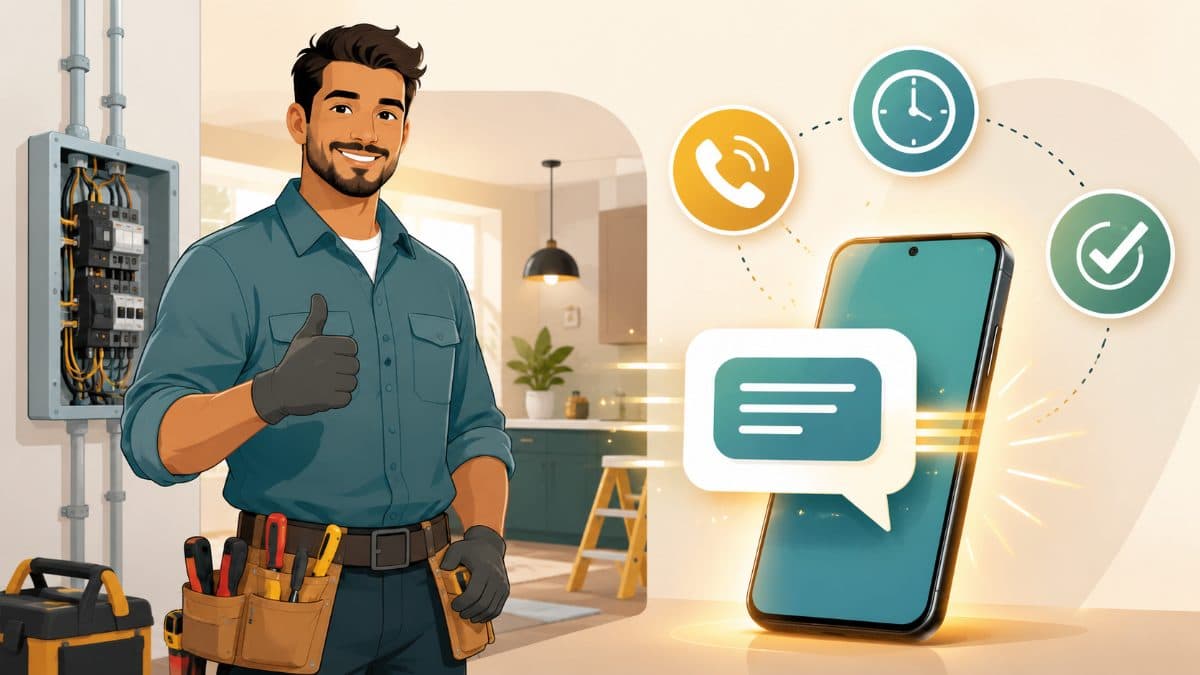
Missed-call text-back is exactly what it sounds like, automated. The moment a call comes in and you don't answer, the system fires off a text to that caller — typically within 30 to 60 seconds — instead of leaving them in voicemail limbo.
The message is simple and human, something like: "Hi, this is Mike at Apex Plumbing — sorry I missed your call, I'm on a job. What do you need help with? I can get you on the schedule."
That one text changes everything for a few reasons. It reaches people where they actually respond: texts have a 98% open rate, and 90% are read within three minutes — numbers voicemail can only dream of. It keeps the customer engaged in the 60-second window when they're still deciding who to call. And it makes you look responsive and professional even though you're literally still holding a wrench.
From there, the conversation continues by text, which most homeowners now prefer. They tell you what's wrong, you (or an AI assistant) ask a couple of qualifying questions, and you get them booked — all without either of you having to stop and talk on the phone.
Adding AI: from "we'll text you back" to "you're booked"
Plain missed-call text-back recovers the lead. Pairing it with AI closes it.
Instead of the conversation waiting for you to free up, an AI assistant can carry it forward automatically: greet the caller, ask what the job is, qualify it ("Is this a repair or a new install? What's your zip code? When works for you?"), and even drop the appointment onto your calendar. The good systems pull leads from everywhere a homeowner might reach you — missed calls, website forms, and lead platforms like Thumbtack, Angi, Yelp, and Google Local Services — and respond to all of them in under 60 seconds, 24/7.
That last part matters more than it sounds. A huge share of home-services inquiries come in after hours — evenings and weekends, when something just broke and the homeowner is anxious and ready to book. A human can't catch those. An always-on AI assistant catches every one, qualifies it, and either books it or has it ready for you first thing in the morning. We go deeper on the always-on side of this in our guide to instant lead follow-up.
The point isn't to remove the human touch. It's to make sure the lead is still warm — and ideally already scheduled — by the time you get off the ladder.
What it's worth to your business
Let's put a dollar figure on it, because that's the only way to know if an automation is worth it.
Say you miss 40 calls a month — conservative for a busy crew. If 85% of those would have gone to a competitor, that's 34 lost opportunities. Even if only a quarter of them were real, bookable jobs, that's roughly 8–9 jobs a month walking away. At an average job value of $300–$500, you're bleeding $2,500 to $4,500 a month out the bottom of the bucket — call it $30,000 to $50,000 a year.
A missed-call text-back system, even with AI layered on top, typically costs somewhere in the range of a single small job per month. The ROI math here isn't close. This is the rare automation that pays for itself with the first recovered job and prints money after that.
That's also why this is the right automation to start with. AI pays off when it handles something repetitive and high-frequency — and for a contractor, missing calls while you work is the most repetitive, high-frequency money-loser there is.
How to set it up without overcomplicating it
You don't need a tech department. A sensible rollout looks like this.
Start with the text-back trigger. Connect a system to your business line so any unanswered call automatically gets a text within a minute. Write the message in your own voice — friendly, specific, with a clear next step ("what do you need and I'll get you scheduled").
Add lead-source coverage next. Make sure web form submissions and your lead-platform inquiries (Angi, Thumbtack, Google LSA) trigger the same instant response. A lead is a lead no matter where it came from.
Layer in AI qualifying once the basics work. Let an assistant ask the two or three questions you always ask anyway, and book straightforward jobs directly into your calendar. Keep it simple — you can always expand later.
Set escalation rules. Emergencies and big jobs should ping you or a dispatcher immediately. Routine stuff can run on autopilot. Start narrow, watch it for a week, then widen what it handles.
The whole thing can be live in a day or two. The mistake is overthinking it — every week you wait is another 30-something leads handed to your competition.
Frequently asked questions
What is missed-call text-back? It's an automated text sent to anyone who calls your business and doesn't get through — usually within 30–60 seconds — so the lead gets an instant response instead of hitting voicemail and calling a competitor.
Does it really make a difference for contractors? Yes. About 74% of contractor calls go unanswered, and 85% of those callers dial a competitor next. Responding within five minutes can boost conversion by up to 400%. Texting back instantly captures leads you're currently losing.
Why text instead of calling back? Texts have a 98% open rate and 90% are read within three minutes, versus voicemails most people never check. Texting also matches how homeowners prefer to communicate and keeps the conversation going while you finish the job.
Can it book the job, or just send a text? With AI added, it can do both — qualify the lead, answer common questions, and book the appointment straight into your calendar, including after hours. Plain text-back recovers the lead; AI closes it.
How much does it cost? Far less than the jobs it recovers. Most contractors lose thousands a month to missed calls, and a text-back system typically pays for itself with the first recovered job.
The bottom line
Every missed call is a homeowner with a problem and a credit card, ready to book the first contractor who responds. Right now, three out of four of them are reaching your voicemail and then your competitor. Missed-call text-back flips that — an instant, friendly reply in the 60-second window when the decision is still up for grabs.
It's cheap, it's fast to set up, and it plugs the biggest leak in most home-services businesses. See how we set this up for contractors with instant lead follow-up and AI, or get in touch and we'll have you catching every call this week.

I help companies turn AI into measurable financial impact. For SMBs, that means automating real workflows, saving real hours, and freeing up teams to grow. For enterprise teams, it means embedding AI into sales, operations, and delivery so the value shows up in lower costs, higher productivity, and revenue growth.